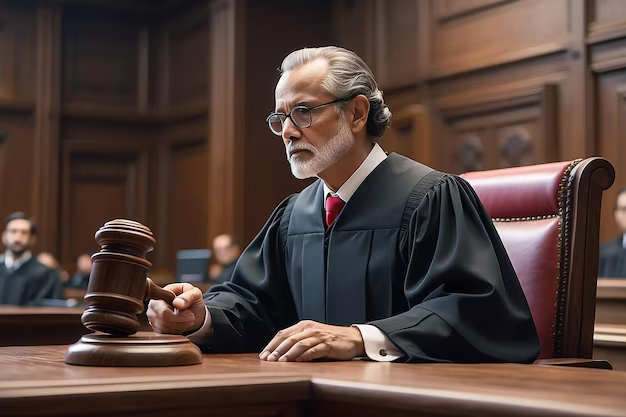
In late 2025, federal judge Jerry Edwin Smith authored one of the most controversial and combative dissenting opinions in recent judicial history — a 104‑page rebuttal to a ruling blocking Texas’ mid‑decade congressional redistricting map. What made this dissent especially notable was not just its length, tone, or timing, but the personal and highly political language Judge Smith used, including repeated references to billionaire donor George Soros and California Gov. Gavin Newsom.
Below, we unpack what happened, why the dissent has captivated public and legal attention, and what it could mean for the 2026 election cycle.
Background: The Texas Redistricting Fight
In 2025, the Republican‑controlled Texas Legislature enacted a new congressional map designed to give GOP candidates a stronger advantage by increasing Republican‑leaning districts from 25 to 30 out of 38 ahead of the 2026 midterm elections.
However, in November 2025, a three‑judge federal panel — including U.S. District Judge Jeffrey Vincent Brown — ruled that the map was likely an unconstitutional racial gerrymander under the Voting Rights Act of 1965 and ordered a return to the 2021 map.
This type of lawsuit pits core principles of election law and racial representation against partisan redistricting strategies. Gerrymandering has long been a contentious issue in U.S. politics, and the legal standards for reviewing such cases are rooted in both constitutional law and federal statute.
For readers unfamiliar, the Voting Rights Act is a major civil rights law intended to protect marginalized voters from race‑based district dilution; you can learn more from the U.S. Department of Justice’s overview. (https://www.justice.gov/crt/voting-rights-act-1965)
The Main Ruling and the Supreme Court’s Interim Response
When the lower court blocked the 2025 map, Texas appealed directly to the U.S. Supreme Court, as required for federal redistricting cases. The Supreme Court issued a temporary stay allowing the contested map’s use in the 2026 primaries while the longer appeal progresses — a decision that sparked criticism and support along ideological lines.
Supporters of the stay argued that delaying implementation could disrupt election preparations, while critics, such as Supreme Court Justice Elena Kagan, warned the move risked perpetuating racial discrimination.
Inside Judge Jerry Smith’s Dissent
While the majority opinion focused on race‑based discrimination, Judge Jerry Smith’s dissent attacked both the process and the personalities involved in issuing the ruling. Unlike typical legal dissents that stick closely to statutory and constitutional analysis, Smith’s critique ventured into unusually personal territory.
Here are the key elements of his dissent:
1. Allegations of “Judicial Misbehavior”
Smith began by accusing his colleague Judge Brown of “pernicious judicial misbehavior” — a strong phrase in judicial parlance — claiming that Brown published the majority opinion too quickly and disadvantaged him by not waiting for Smith’s own written response.
He wrote that in 37 years on the bench, he had never experienced such conduct, framing it as both procedural unfairness and a betrayal of collegial judicial practice.
This procedural argument was just the warm‑up for what became the more dramatic elements of his dissent.
2. Partisan Rhetoric and Political Naming
Unusually, Smith repeatedly referred to billionaire philanthropist George Soros and California Gov. Gavin Newsom — neither party to the case — claiming the “winners” from the majority opinion were these outside political figures.
In the opening line of the dissent proper, Smith wrote:
“The main winners from Judge Brown’s opinion are George Soros and Gavin Newsom.”
This invocation of outside political actors is rare in judicial opinions and drew widespread commentary from legal observers. The dissent mentions Soros as many as 17 times — far exceeding the normal scope of judicial analysis.
Legal analysts noted that Smith’s logic was not only partisan but also largely unsupported by the record, given that neither Soros nor Newsom was an actual party or direct actor in the litigation.
🪄 3. Attacks on Judicial Reasoning
Smith also derided Brown’s legal reasoning with colorful language, labeling the majority opinion as deserving of a “Nobel Prize for Fiction” and mocking Brown as an “unskilled magician” — metaphors seldom seen in judicial dockets.
He argued that Brown’s application of law was “misleading,” that it lacked proper weight on expert testimony, and that the inquiry into legislative intent was flawed under redistricting precedents.
Smith even referenced 20th‑century courtroom clichés and popular culture to make his point — a stylistic choice that blurred the line between traditional judicial critique and theatrical commentary.
4. Partisan vs. Racial Claims
A central legal debate in the case is whether Texas’ redistricting was primarily a partisan strategy or if it crossed into racially discriminatory territory. Usually, courts must analyze whether race was the predominant factor in drawing districts, a principle rooted in key Supreme Court precedents about racial gerrymandering. (See SCOTUSBlog on Race and Redistricting, https://www.scotusblog.com/?s=racial+gerrymandering)
The majority found enough evidence to justify that race played an improper role, though Smith disputed both the evidence and the legal framework used to reach that conclusion.
Why This Dissent Matters
Impact on the 2026 Elections
The fight over Texas’ map is far from academic. The outcome affects how millions of Texans will be represented in the 2026 U.S. House elections, which in turn affects the national balance of power in Congress.
With a temporary stay from the Supreme Court in place, the new map is currently allowed for use — but that could change with further appeals.
Judicial Tone and Institutional Integrity
Smith’s dissent ignited debate about the role of federal judges in political controversies. Judicial norms generally value restraint, impartiality, and deference to evidence rather than rhetoric and personal attacks. Many observers argued that while judges reserve full rights to dissent, the tone of a judicial opinion should avoid undermining confidence in the judiciary itself.
The Broader Legal Precedent
Cases like this aren’t isolated: other redistricting battles are underway in states like Georgia, North Carolina, and Louisiana, with national implications for how courts balance partisan strategy and racial fairness. (See NCSL on Redistricting Trends, https://www.ncsl.org/research/redistricting.aspx)
Many legal scholars note that decisions in 2025–2026 could reshape judicial standards for mid‑decade redistricting, particularly around the Purcell principle — a doctrine advising courts to avoid changing election rules close to elections to prevent voter confusion. (See Oyez on Purcell v. Gonzalez, https://www.oyez.org/cases/2006/05-229)
What Legal Experts Are Saying
Legal experts broadly agree:
- Personal and partisan language in judicial opinions can erode public trust in impartial adjudication.
- The underlying constitutional questions about redistricting and racial discrimination remain unsettled and complex.
- The Supreme Court’s eventual review could clarify important facets of election law and federal‑state balance.
Some commentators also caution that Smith’s extreme rhetoric — while provocative — may have less legal influence than more measured dissents that ground arguments strictly in precedent and statute.
Conclusion
Judge Jerry Smith’s 2026 dissent in the Texas redistricting case stands as one of the most rhetorically charged opinions in recent judicial history. Its combination of legal disagreement, colorful language, and partisan invocation has sparked debate about judicial norms, political influence in the judiciary, and the future of redistricting law.
Regardless of where one stands politically, this case highlights how legal reasoning, public perception, and constitutional interpretation collide in high‑stakes elections that shape the future of American democracy.